Where to Go in China for a First Trip
Choose where to go in China for a first trip, with practical route ideas for Beijing, Xi'an, Shanghai, Chengdu, Guilin, Yunnan, Guangdong, and seasonal planning.
travel better
On this page
Quick Answer
For a first trip to China, most travelers should choose one clear route instead of collecting too many cities. The right route depends on what you came for: imperial history, food, city walks, slow towns, mountains, tea, or local neighborhoods. Beijing, Xi’an, and Shanghai can be a good classic history route, but they are not the automatic answer for every traveler.
If a standard “top attractions” list feels too shallow, consider a Guangdong food and local-life line, a slower Yunnan line, a Shanghai/lower Yangtze city-walk line, a southwest food-and-tea route, or a focused history route. If you want the classic 10-day history overview, use the 10-day China itinerary. If you still need the practical setup, start with the first-time China planning guide.
China is not one destination. It is a continent-sized country with ancient capitals, neon skylines, mountain villages, desert towns, subtropical food cities, tea regions, river landscapes, and high-speed rail corridors. The hard part for a first trip is not finding enough places. The hard part is choosing fewer places so the trip still feels like travel, not a transit project.
Use this guide as a bridge between inspiration and planning. Famous places are included when they genuinely help a first-time route, but the better trip often comes from food streets, local neighborhoods, slower towns, rail logic, and the less obvious places that explain how people actually live.
Guangdong deserves more space than many first-trip lists give it. It is one of the best regions for travelers who want dim sum, Chaoshan food, Shenzhen urban villages, Shunde kitchens, and everyday city texture rather than another crowded photo stop.
How to Choose Your First China Destinations
Start with the kind of trip you want, then choose the geography that makes sense. If you want imperial history, choose a northern or central history route. If you care more about landscapes, give nature enough time instead of adding it as a side trip. If you travel for food, Guangdong, Chengdu/Chongqing, and the lower Yangtze can be more satisfying than rushing through famous checklist cities. If you want slow travel, Yunnan deserves to be the main route, not a quick add-on.
Beijing, Xi’an, Luoyang, Nanjing, or Shanghai can work when the trip is built around history and museums.
Guilin/Yangshuo, Yunnan, Zhangjiajie, or Sichuan work better when you slow down.
Guangzhou, Shunde, Chaozhou, Shantou, Chengdu, Chongqing, Shanghai, and Shenzhen work best when grouped by region.
Use three filters before you fall in love with a map: how many nights you have, how many transfers you can tolerate, and whether the destination fits the season. The best time to visit China guide is useful here because China can be very different in spring, summer, autumn, and winter.
The route should explain itself
A good first route has a natural logic: north to east, east to southwest, or one region in depth. A weak route jumps between famous places because each one looks interesting in isolation. The best test is simple: can you explain why the next city follows the previous city?
For example, Guangzhou to Shunde to Chaozhou or Shantou is a food route. Kunming to Dali to Shaxi or Xizhou is a slow Yunnan route. Shanghai to Suzhou to Hangzhou is a compact lower Yangtze route. Beijing to Xi’an to Luoyang or Nanjing is a history route. Each one has a reason beyond connecting famous names.
A better route question: do not start with “What are the top 10 places?” Start with “What kind of China do I want to understand?” A classic route teaches you the national frame. A Guangdong line teaches you food, commerce, migration, and local life. A Yunnan line teaches you pace and atmosphere. A Shanghai walking route teaches you museums, architecture, and everyday urban detail. The best first trip may be famous, local, or mixed, but it should not feel copy-pasted from a viral checklist.
Places to Save for a Second Trip
Some destinations are extraordinary but not always right for a first China route. This does not mean they are less worthy. It means they need more days, more logistics, better seasonal timing, or a more specific travel purpose. Saving them for a second trip can make both trips better.
Tibet, Xinjiang, Inner Mongolia, far northeast winter routes, deep rural Guizhou, and long Silk Road itineraries can be unforgettable, but they are not simple add-ons to Beijing, Xi’an, and Shanghai. They involve longer distances, weather exposure, permit or route complexity, fewer English-language services, or more demanding transport days. If one of these regions is your dream, build the whole trip around it instead of adding it as a quick side stop.
Even popular scenic destinations need respect. Zhangjiajie, Jiuzhaigou, Huangshan, Guilin/Yangshuo, and Yunnan all reward slower pacing. A mountain or landscape route can be disappointing if you arrive for one rushed day in bad weather after a long transfer. For nature, fewer bases and more flexibility usually beat a faster checklist.
Second-trip mindset: your first trip should teach you how China travel works. Your second trip can go deeper into the region that stayed in your mind.
The Classic History Route
A classic history route can use Beijing, Xi’an, and Shanghai, but it should be chosen for a reason: imperial history, ancient capital texture, museums, strong rail links, and a practical international gateway. For some travelers, Luoyang or Nanjing may make the historical line more coherent than forcing a modern-city ending.
Even on a famous history route, do not only chase the most photographed viewpoints. In Beijing, leave time for neighborhoods and everyday meals. In Xi’an, care about noodles and the city wall, not only the Terracotta Warriors. If you add Shanghai, use walks and museums to understand the city rather than treating the Bund as a single photo stop.
The practical advantage is transport. Beijing, Xi’an, Luoyang, Nanjing, and Shanghai sit on strong rail and flight networks, so the route can stay understandable without remote transfers, mountain weather, or too many one-night stops.
Beijing
Best for first contact with imperial China: Forbidden City, Temple of Heaven, Summer Palace, hutongs, and a Great Wall day trip. Beijing is large, so give it time and avoid cramming every monument into one day.
Xi’an
Best for the Terracotta Warriors, city wall, Muslim Quarter food, and an inland historical atmosphere. Xi’an works well as a two-night stop between Beijing and Shanghai.
Shanghai
Best for modern China, architecture, museums, waterfront walks, cafes, and easy day trips. Start with the Shanghai travel guide for the city layer, then use the four days in Shanghai itinerary if you want a detailed walking plan.
High-speed rail spine
Use rail when the timing is sensible and compare flights for longer legs. The China high-speed rail guide explains the station and ticket process.
Best China Destinations for First-Time Travelers
Use this matrix to decide what belongs in your first trip and what can wait. The goal is not to rank every city in China. The goal is to match destinations with travel styles and realistic time.
| Destination | Best for | Minimum time | First-trip fit |
|---|---|---|---|
| Beijing | Imperial history, Great Wall, museums, hutongs | 3-4 nights | Strong for history-focused routes |
| Xi’an | Terracotta Warriors, city wall, noodles, inland history | 2 nights | Strong classic-route stop |
| Shanghai | Modern city walks, museums, Bund, easy departure | 3 nights | Excellent first or last city |
| Chengdu | Pandas, Sichuan food, teahouses, relaxed city life | 3 nights | Best as a focused Sichuan branch or add-on |
| Guilin/Yangshuo | Karst scenery, river landscapes, cycling, villages | 3 nights | Great nature branch if weather fits |
| Yunnan | Dali, Shaxi, Xizhou, old towns, minority cultures, slow travel | 7+ nights | Better as a focused route than a rushed add-on |
| Guangdong | Cantonese food, dim sum, Shunde, Chaozhou, Shantou, Shenzhen urban villages, local city life | 5-10 nights | Strong route for food-first travelers, not just repeat visitors |
| Zhangjiajie | Mountain scenery and dramatic landscapes | 3 nights | Worth it if nature is the priority, but not a simple add-on |
Choose by Travel Style
Different travelers should choose different first routes. A museum-focused traveler and a food traveler do not need the same China itinerary. A photographer chasing mountains should not copy a business traveler flying into Shanghai for three days. Use the route style below as your decision shortcut.
Beijing -> Xi’an -> Luoyang or Nanjing, with Shanghai only if you want a modern city ending.
Shanghai -> Suzhou -> Hangzhou or Nanjing, with museums, waterfronts, gardens, and slower city walks.
Guangzhou -> Shunde -> Chaozhou/Shantou -> Shenzhen, using Guangdong’s existing food strength.
Kunming -> Dali -> Xizhou -> Shaxi, using Yunnan as a destination rather than a checklist add-on.
Guilin/Yangshuo or Zhangjiajie, with fewer cities and more weather flexibility.
Choose two easy bases in one region, add one gentle side trip, and avoid repeated hotel changes.
For food-focused travelers, Guangdong deserves special attention because Shunde, Chaozhou, Shantou, Chaoshan, Shenzhen, and Dongguan can form a real regional food route rather than a single-city add-on. Start with the Guangdong food and travel guide, then use the Shunde food guide and Shenzhen food and culture guide for city detail.
Food travelers: why Guangdong can beat a checklist route
If food is the main reason you travel, a Guangdong route may be more memorable than a classic monument route. Guangzhou gives dim sum and old urban texture, Shunde gives one of China’s strongest culinary identities, Chaozhou and Shantou open the Chaoshan food world, and Shenzhen adds migrant-city energy, urban villages, design spaces, and practical transport. This route is not the default answer for every first-time visitor, but it is a strong answer for travelers who choose meals as carefully as museums.
The advantage is density. You can move through Guangdong with shorter transfers than many cross-country routes, and every stop has a food reason to exist. The tradeoff is that it gives less imperial or ancient-capital history, so it works best when food, local neighborhoods, and modern southern China are the main reasons for the trip.
Slow travelers: why Yunnan needs time
Yunnan is often recommended because it looks beautiful in photos, but it should not be treated like a two-night ornament. Dali, Xizhou, Shaxi, Lijiang, Shangri-La, and smaller villages each have a different pace. The best Yunnan trips include unstructured time: markets, courtyards, mountain views, guesthouses, local food, and quiet mornings. If you only have 10 days total in China, Yunnan may force you to cut too much from the rest of the route.
For travelers who prefer atmosphere over checklists, Yunnan can be a better first trip than the classic route, but it should be the main route. Start with the Yunnan travel guide for slow travelers, then use the two-week Yunnan slow travel route for deeper pacing detail.
Route Ideas by Trip Length
The number of nights matters more than the number of cities. A first China trip should leave space for jet lag, large stations, museum reservations, weather, and meals that deserve time. These route ideas are starting points, not rigid templates.
The route ideas below are organized by route logic, not by forcing every traveler through the same gateway cities. Many travelers get a better trip from one clear regional story than from a crowded list of famous stops. The goal is not to avoid famous places at all costs. The goal is to choose places with a reason.
7 days: one region, two bases
Choose one compact story: Guangzhou + Shunde, Shanghai + Suzhou/Hangzhou, Beijing + Xi’an, Chengdu + Leshan, or Dali + Xizhou/Shaxi. A week is too short for cross-country collecting.
10 days: choose one strong line
Choose the line that matches your purpose: Beijing -> Xi’an -> Luoyang/Nanjing for history, Guangzhou -> Shunde -> Chaozhou/Shantou for food, Shanghai -> Suzhou -> Hangzhou for city walks, or Kunming/Dali -> Xizhou -> Shaxi for slow travel. The 10-day China itinerary is one classic option, not the only template.
14 days: add one branch
Add only one branch if it has a clear purpose: Chengdu for teahouses and Sichuan food, Guilin/Yangshuo for karst scenery, Yunnan for slower towns, or Guangdong for a food-first regional trip.
10-14 days: Guangdong food line
Use Guangzhou or Shenzhen as the gateway, then build a compact food route through Shunde and the Chaoshan side if time allows. Start with the Shunde food guide, add Shenzhen for urban villages and museums, and choose Chaozhou or Shantou for deeper Chaoshan food. This line is especially strong for repeat Asia travelers or first-timers whose main priority is food.
2+ weeks: choose a theme
Use two weeks for depth: a full Guangdong food route, a slow Yunnan route, a lower Yangtze city route, a history route with Luoyang or Nanjing, or a southwest food-and-tea route. The route should have a point of view.
When you compare routes, check the transport before you emotionally commit. The China domestic travel guide helps you decide when to use trains, flights, or buses.
How to combine cities without making the trip exhausting
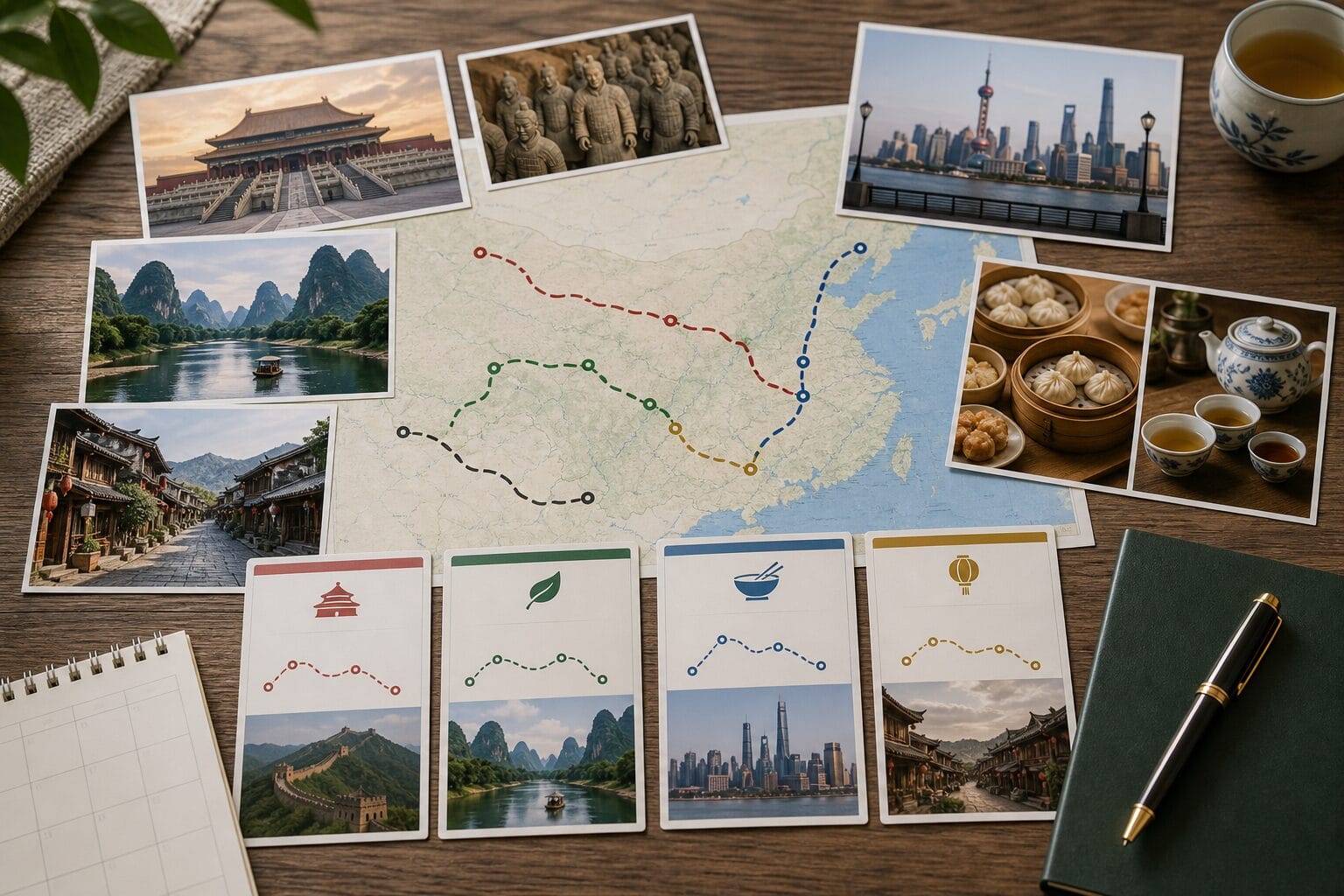
A good city combination has one of three patterns. The first is a regional loop: Guangzhou to Shunde to Chaozhou or Shantou, Kunming to Dali to Shaxi, or Shanghai to Suzhou to Hangzhou. The second is a rail spine with a clear story, such as Beijing to Xi’an to Luoyang or Nanjing. The third is a hub-and-branch route, such as Chengdu plus Leshan, Guangzhou plus Shunde, or Shanghai plus Suzhou.
The weakest pattern is random long-distance zigzagging. Beijing, Zhangjiajie, Guilin, Shanghai, and Harbin can all be excellent, but together they create too many disconnected jumps for most first trips. If a route needs multiple flights and several one-night stays, it usually needs fewer destinations or more days.
| Route pattern | Example | Why it works |
|---|---|---|
| Rail spine | Beijing -> Xi’an -> Luoyang/Nanjing, or Shanghai -> Suzhou -> Hangzhou | Clear story, strong transport, and each stop adds a new layer. |
| Regional cluster | Shanghai -> Suzhou -> Hangzhou | Short transfers, good food, gardens, museums, and city walks. |
| Food region | Guangzhou -> Shunde -> Chaozhou/Shantou | Every stop has a food reason, and distances stay manageable. |
| Slow region | Kunming -> Dali -> Xizhou -> Shaxi | Fewer bases, more atmosphere, better for slow travel. |
| Hub plus branch | Guangzhou -> Shunde, Chengdu -> Leshan, Shanghai -> Suzhou, Dali -> Shaxi | Works when the branch is close enough to protect time on the ground. |
Season Fit Matters
Spring and autumn are the most forgiving seasons for a first China trip. Summer can be hot, humid, crowded, and rainy in many regions, though it can still work if you plan around weather. Winter can be excellent for Beijing, museums, hotpot, and some northern experiences, but it is less ideal for every nature route.
| Season | Good first-trip choices | Be careful with |
|---|---|---|
| Spring | Beijing, Shanghai, lower Yangtze, Yunnan | Holiday crowds and changeable weather |
| Summer | Yunnan, higher-elevation routes, indoor-heavy city trips | Heat, humidity, rain, school-holiday crowds |
| Autumn | History routes, Beijing, Xi’an, Guangdong food trips, Yunnan | National Day Golden Week crowds |
| Winter | Beijing, Shanghai museums, Sichuan food, Harbin if winter is the point | Cold northern weather and shorter daylight |
If your dates are fixed, choose the destination around the season. If your destination is fixed, choose dates around the destination. The mistake is forcing a dream route into a bad weather window without adding flexibility.
Common First-Trip Mistakes
- Too many cities. China rewards depth. Three strong destinations usually beat six rushed ones.
- Ignoring arrival city logic. Your international flight should support the route, not fight it. Read the flying to China guide before booking.
- Saving logistics for later. Payment, internet, apps, and train tickets should be solved before the trip feels urgent.
- Making every transfer a sightseeing day. Long stations, airports, and hotel changes take energy.
- Choosing famous places over a coherent route. A destination can be amazing and still not belong in your first itinerary.
- Following viral checklists too closely. A trip built only around internet-famous photo spots often misses food, neighborhoods, local rhythm, and the reasons a place matters.
- Ignoring Guangdong because it feels less “classic.” If food, trade, local city life, and regional culture matter to you, Guangdong may be more rewarding than another overloaded monument day.
Simple rule: for a first China trip, choose one main story. Classic China, food China, nature China, or slow China. You can always build the second story on your next trip.
How to decide when two routes both look good
If you are torn between two routes, choose the one with fewer fragile links. A fragile link is a late-night arrival, a same-day flight-to-train connection, a scenic destination that depends heavily on weather, or a city you are adding only because it is famous. Remove the weakest link and see if the route feels better. It usually does.
Also consider the first and last day. A route that starts with a long-haul flight, then a domestic flight, then a late taxi transfer is not a gentle introduction. A route that ends with a domestic connection before an international flight can create stress. First-time travelers usually do better with a soft landing city and an easy departure city, even if that means skipping one famous place.
Official Sources and Planning Guides
This guide uses official heritage and destination context where helpful, including UNESCO pages for the Great Wall, the Mausoleum of the First Qin Emperor, and UNESCO Creative Cities context for Shunde as a City of Gastronomy, plus current practical travel planning resources. Destination choice is partly personal, so treat this as a planning framework rather than a universal ranking.
FAQ
What are the best places to visit in China for a first trip?
There is no single best first route for every traveler. Choose by style: northern or central history for imperial and ancient-capital depth, lower Yangtze for city walks and museums, Guangdong for food and local life, Yunnan for slow travel, and Guilin/Yangshuo for scenery.
Is 10 days enough for China?
Ten days is enough for one focused route. It is not enough to collect every famous region, so choose one main line and avoid adding long-distance branches without a clear reason.
Should I visit Guilin, Chengdu, or Yunnan on a first trip?
Yes, if you have enough time and the destination matches your travel style. Guilin/Yangshuo is best for karst landscapes, Chengdu for Sichuan food and relaxed city life, and Yunnan for slow travel. They are better with extra days rather than as rushed add-ons.
Is Shanghai worth visiting on a first China trip?
Yes, if it fits your route. Shanghai is strong for city walks, museums, architecture, food, international flights, and lower Yangtze day trips, but it is not mandatory for every first China itinerary.
How many cities should I visit in China on a first trip?
For 7 days, choose one compact region with two bases. For 10 days, choose one clear line with two or three stops. For two weeks, add one branch only when the transport and travel purpose make sense.
Is Guangdong a good choice for a first China trip?
Yes, especially if you travel for food, local neighborhoods, modern city life, and regional culture. Guangdong is less of a standard postcard route, but it can show a real, lived-in side of China through Shunde, Guangzhou, Shenzhen, Chaozhou, and Shantou.
Enjoyed this article? Consider buying me a coffee to support more content like this!
💖 0 people have clicked to support this article.